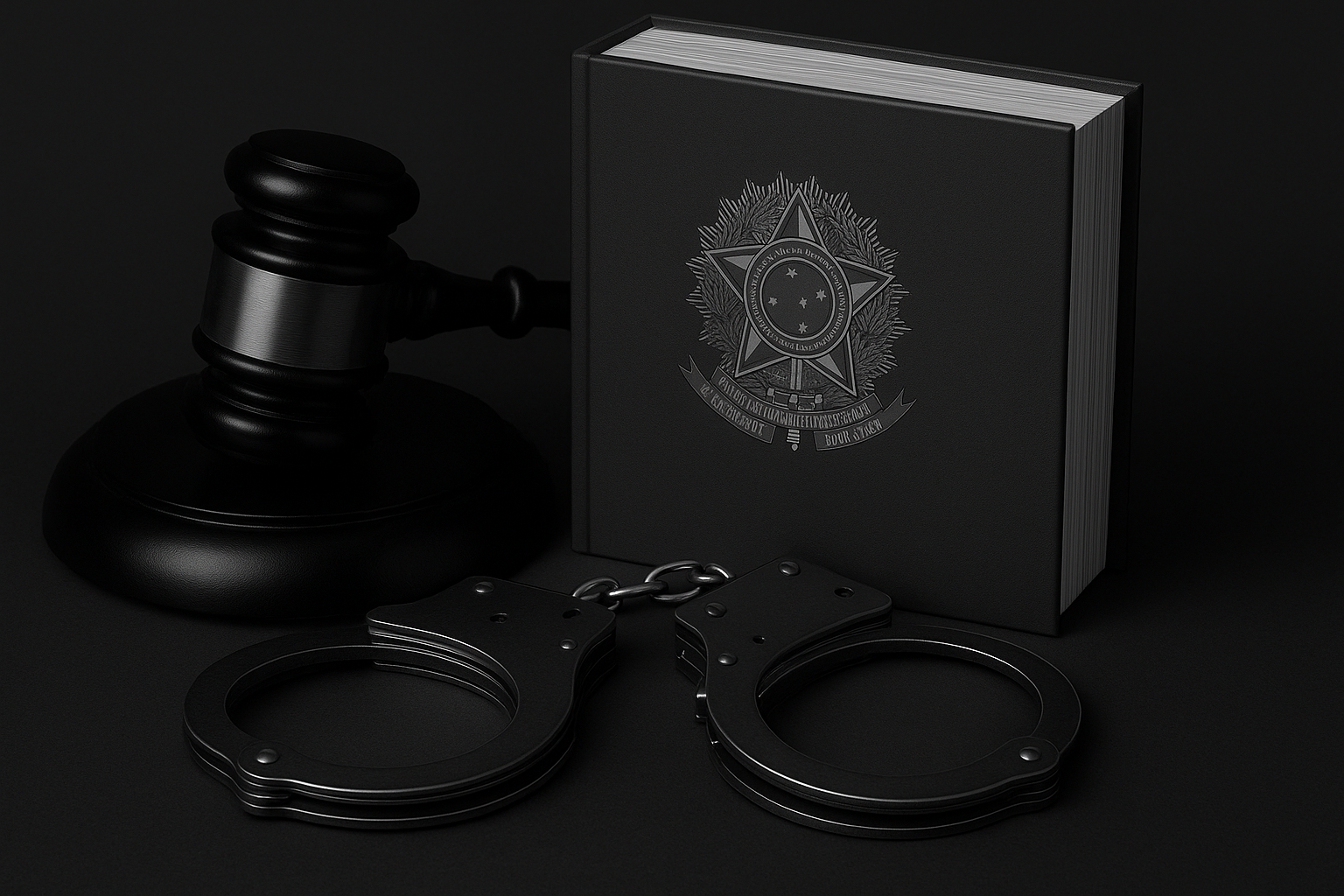
In the Brazilian legal imagination, the Supreme Federal Court should be the shield of fundamental freedoms. But in recent years, this image has crumbled under the weight of increasingly centralized and arbitrary decisions. The Supreme Federal Court, once the guarantor of the Constitution, has become the validator of an informational regime where criticism has become a crime and doubt is treated as democratic sabotage.
History isn't made with tanks alone—sometimes, a robe and forced silence are all it takes. In the name of "defending democracy," Supreme Court justices have been constructing a parallel jurisprudence that transforms freedom of expression into an institutional threat. The problem isn't isolated. It's structural. And it's already underway.
Read more: The toga that silences: behind the scenes of Supreme Activism When the Court Legislates: The End of the Separation of Powers
From guardian of the Constitution to guarantor of the TSE
Article 102 of the Constitution is clear: the Supreme Federal Court (STF) is responsible for safeguarding the Constitution. Not for creative interpretation according to the moods of the times, but for protecting the letter and spirit of the constitutional text. However, in the name of institutional stability, the Court has begun to uphold decisions that blatantly violate the right to free expression of thought—especially when they originate from the Superior Electoral Court (TSE).
The Supreme Court now endorses prior censorship, content removal, profile blocking, subpoenas without due process, and even political persecution under the guise of combating disinformation. It doesn't matter if the content is true. It's enough that it contradicts the "democratic consensus"—an empty concept, but useful to power.
The paradigmatic case of the fake news inquiry
No analysis of the Supreme Federal Court's role in contemporary censorship would be complete without mentioning the infamous Inquiry 4,781, initiated ex officio by Dias Toffoli and reported on by Alexandre de Moraes. A case without a victim, without a prosecutor, and with handpicked defendants. A legal mockery that became state policy.
From then on, the door was opened to institutionalized repression. Journalists, comedians, political analysts, and even parliamentarians began to be investigated and punished for opinions considered "threats"—not to order, but to the institutional comfort of those at the top. Censorship, once fought as an authoritarian legacy, became normalized under the guise of institutional protection. Dissenting voices were transformed into targets of investigations, conducted without due process, with disproportionate and punitive measures. In a country where satire becomes a threat, denunciation becomes fake news, and protest becomes an attack, there is no room for honest debate. The fake news investigation has become a legal laboratory of exception, testing how much the state can silence before society reacts—or conforms. What began as a specific case is now a model of repression replicated and legitimized by the country's highest court.
The rhetoric of anti-democratic discourse
The Supreme Federal Court's new mantra is that "freedom of expression is not freedom of aggression." A beautiful phrase that serves as a codeword to criminalize any dissenting voice. The Court no longer distinguishes between actual incitement and harsh criticism; irony and threat; and accusation of subversion.
Based on this doctrine, the Supreme Court endorses actions such as:
- summary removal of content on networks;
- arrest warrants against communicators;
- search warrants at the homes of critics of the Judiciary;
- blocking of bank accounts and social networks;
- co-optation of fact-checking agencies as a source of evidence.
Freedom, which should have been a principle, became a temporary concession — revocable at any time by a single decision.
The contrast with liberal democracies
Countries like the US, Germany, and the UK have much more robust systems for protecting freedom of expression—including for harsh speech against institutions. There, criticism of the Supreme Court would be a legitimate part of the public arena. In Brazil, it has become a crime against the nation.
Instead of following the liberal standard, the Brazilian Supreme Court (STF) opted for a symbiosis with the Executive and the Superior Electoral Court (TSE), forming a triad that concentrates power, regulates debate, and punishes dissent. It's the opposite of a functional democracy. It's a sham.
What Rothbard said about courts in authoritarian regimes
Considering the spirit of Murray Rothbard's ideas, in his classic "What Has the Government Done to Our Money?", it can be stated: the institutions that should contain the government end up being co-opted by it, transformed into instruments of coercion and retroactive justification of abuses.
This is precisely the current role of the Supreme Federal Court: a court that, instead of protecting the Constitution against the State, protects the State against the Constitution.
Conclusion
There is no democracy without freedom of expression. And there is no freedom of expression when the nation's highest court becomes a guarantor of censorship. The Supreme Federal Court (STF) abandoned its role as the Constitution's shield to don the mantle of absolute moral authority. The result? A country where questioning has become a crime, and thinking out loud can be costly.
Read also:
Who watches the watchmen? The TSE and the monopoly of official truth
STF, TSE and the blurred line between power and censorship
Democracy in silence: the return of single-minded thinking





 English
  Portuguese